All About Quadratic Equations: Solve, Understand & Calculate with Confidence
Quadratic equations are far more than just an algebra exercise — they show up in surprisingly practical situations, from tracking the arc of a basketball shot to applying formulas in physics and business modeling. At their core, these equations follow the form ax2 + bx + c = 0, where a, b, and c are coefficients and x is the variable you’re solving for (where a ≠ 0). Once you learn to solve them step by step, you begin to understand the curves, changes, and patterns that are everywhere around us. Whether you’re working with a simple quadratic expression or a full second-order polynomial, getting comfortable with the process means you can decode real-world behavior far more clearer and faster than most expect. Tools like the Calcful calculator make it easier to enter the coefficients a and b and the constant c, and instantly get a complete solution with show-work steps included.
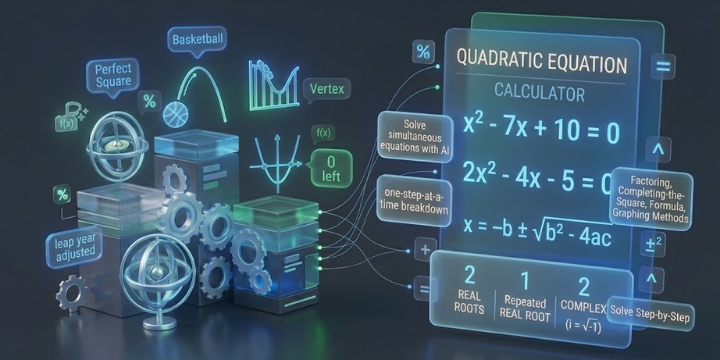
The online solver uses the quadratic-formula to solve any second-order-polynomial equation, and the solution hinges on whether the discriminant — expressed as b2 − 4ac — is zero, positive, or negative. When b² − 4ac equal-to 0, there is one-real-root; when it is greater-than 0, the calculator determines there are two-real-roots; and when it falls less-than 0, it produces two-complex-roots. This distinction matters enormously in real problem-solving because complex roots and real roots behave very differently across fields. By reviewing the entered values and the formula logic, users gain not just answers but genuine understanding — which is, really, the deeper purpose behind any 2nd order math tool. The process isn’t just about speed; it’s about learning to think at the right level, so you never just look at a result — you understand what it means. With less friction and greater clarity, the quadratic-formula calculator helps you approach every equation with confidence, whether for academics, business modeling, or applied physics.
Quadratic Formula & What Is a Quadratic Equation? Your Complete Guide to Solving ax² + bx + c = 0
Understanding what makes an equation truly quadratic starts with recognizing its form: it must be expressible as ax2 + bx + c = 0, where a is not-zero — this single condition separates a genuine second-order polynomial from simpler linear expressions. The name itself traces back to “quad,” meaning “square,” since the variable x is always squared — making x2 the defining feature of every quadratic structure. These equations appear in many different forms, sometimes in standard-form and sometimes in-disguise, but they all share the same underlying logic. For example, x2-3x+1 = 0 has a=1, b=-3, c=1; the expression 2×2-4x-5 = 0 carries a=2, b=-4, c=-5; while x2-x-3 = 0 gives a=1, b=-1, c=-3; and even 5×2 + x-1 = 0 fits perfectly with a=5, b=1, c=-1. Recognizing coefficients a, b, and c across these disguise cases — including expressions involving 1/x or 1/x2 — is a foundational skill that directly supports your ability to solve-quadratic problems at any degree or complexity level. Tools like a Root Calculator or Exponent Calculator complement this process well, especially when simplifying intermediate steps.
The formula used to solve these equations — the iconic quadratic formula-expression x-equals −b ± √b²−4ac divided by 2a — is built from the numerator containing negative-b combined with the ± radical of b-squared − 4ac, all over the denominator 2a. The discriminant, represented as 4ac subtracted from b-squared, determines how many real roots exist: a positive value yields two distinct roots, zero gives one repeated root, and a negative result produces complex solutions beyond the real number line. Whether the polynomial arrives as a tidy standard expression like 3x − 1 rearranged into x2 − 3x + 1 = 0, or in a less obvious disguise involving products like x-1 multiplied out to give x2-x-3 = 0, the formula applies universally across all forms and order-of-2 structures. For broader mathematical workflows, pairing this tool with a Scientific Notation Calculator or a Speed Distance Time Calculator makes applied problem-solving far more efficient — and exploring the full All Math Calculators Category ensures you always have the right tool for every equation you encounter.
How to Solve a Quadratic Equation? Four Proven Methods Explained
There are four core methods and ways to solve a quadratic equation, and choosing the right one depends entirely on the situation. Factoring is often the first approach — it works by rewriting the expression as a product of binomials with two-terms, such as x-2 or x+3. It’s quick, neat, and works best when the numbers are easy to spot. A real-life classroom example makes this concrete: imagine planning a soccer-field where the total area should be 30 square-meters, the width is x-3 meters, and the length is x meters. Writing length×width gives us x(x-3)=30, which expands into x²-3x-30 = 0, then factors as x-6 and x+5 = 0. Since length can’t be negative, we discard x=-5 and confirm x=6 — giving a field of six by three meters. When factoring isn’t straightforward, completing-the-square steps in: it converts the equation into a perfect-square form, revealing the vertex — the turning-point on the curve, whether it’s the bottom of a dip or the top of a hill. Take s(t) = t²+4t+1, a pattern tracking savings over weeks — rewriting it as (t+2)²-3 immediately shows where savings are at their lowest before growing quickly again, a practical insight useful well beyond any school project or video-game budget tracker.
Using the Quadratic Formula and Graphing to Solve Any Equation
For tricky equations that resist factoring, the quadratic-formula is the universal, reliable tool: x = -b ± √ (b²-4ac) / 2a. Here, the discriminant b²-4ac is the key indicator — positive means two real roots, zero means one repeated root, and negative signals imaginary or complex roots expressed using i, the symbol for √-1. Consider a basketball thrown in gym-class: its height follows h(t) = -5t²+10t+2, where -5t² governs the downward arc, 10t the upward momentum, and 2 the initial height. Setting this to zero and applying the formula tells us exactly when the ball hits the ground — the path it traces is a parabola, whose peak is the vertex and whose x-intercepts are the solutions. Graphing offers yet another perspective: plotting P(x) = -2x²+12x-10 for a bake-sale profit model reveals where the curve crosses the x-axis (the break-even point), where intercepts mark zero profit, and where the highest-point of the graph shows maximum returns — while the lowest-point signals minimum or loss territory. The shape of the parabola visually communicates what decimals and fractions alone cannot: that selling too few or too many cupcakes both reduce profit, with costs, leftovers, and extra overhead factoring in beyond what the raw equation shows.
Common Mistakes When Solving Quadratic Equations and How to Avoid Them
Even with the right method, incorrect results often come from avoidable errors — and practice in identifying these is just as valuable as knowing the formula itself. The most common mistake is not rewriting the equation in standard-form first: an expression like x²+5x-6 = 0 must be fully set to 0 before plugging values into any method. Mixing-up the coefficient values of a=1, b=-7, c=10 — or misreading a=2, b=-4, c=-5, or a=5, b=1, c=-1 — leads to a completely wrong-answer, since even one transposed value corrupts the entire calculation. Sign-errors are equally damaging: always use parentheses when handling negative-signs, because negative values like b=-3 or -10 flip the result entirely if mishandled. Another frequent issue is incorrect square-root simplification — writing √18 as 3 instead of 3√2 produces an incomplete final-answer. Finally, confusing complex-numbers for “no solution” is a critical error: a negative discriminant doesn’t mean failure — it means the equation has imaginary-solutions that Calcful ‘s AI math-solver handles clearly, including √-1 expressed as i. Using the one-step-at-a-time feature while calculating step-by-step — whether by hand or calculator — makes tracking errors far easier, turning everyday school or applied real-life designing tasks into confident, accurate problem-solving.
Real-Life Applications of Quadratic Equations: Where the Math Actually Shows Up
Most people first meet quadratics in math homework, but these equations quietly navigate far more of everyday life than they might expect. The arc of a perfect-shot in basketball — that smooth, rising-then-falling curve — is a parabola, and a quadratic-equation can tell you exactly how high the ball goes, where its peak is via the vertex, and when it lands using the x-intercepts. The same physics-motion logic applies to dropped-keys, thrown-frisbees, roller-coaster drops, and any other falling or flying object — each traces a curve-shape that follows a quadratic-formula pattern. Even game-design and animation rely on this: characters jumping, arrows flying, or balls bouncing off walls all run on behind-the-scenes quadratic equations that make motion look visually natural and practical rather than robotic. Whether applied in a field simulation or a project involving animation-characters, the shape of the curve is always governed by the same underlying math.
Beyond physics and game mechanics, quadratics show up in surprisingly human decisions — especially those involving balance between too little and too much. A bake-sale is a perfect example: sell too-little and you lose-money; sell too-much and you waste ingredients and effort. Somewhere in-between lives the sweet-spot — your maximum-profit — and a quadratic helps you find it through profit-finding calculations grounded in real patterns. The same logic applies to garden-design or poster-layout: when you need to fit a fixed-area within changing-dimensions, the quadratic-formula solves for the right length and width without guesswork. A design decision that might take hours of trial and error ends-up resolving quietly and cleanly once the equation is set up correctly — whether it’s a garden, a poster, a layout, or any space where a fixed area meets changing dimensions. These applications prove that quadratic thinking isn’t abstract — it’s a practical, everyday tool for anyone willing to navigate real problems with structured math.
The broader value of understanding real-life quadratic-equation applications is that it reframes how you live with curves and arcs around you. The intercepts on a graph aren’t just coordinates — they’re the moment a roller coaster hits the ground, the point where profit turns to loss, or the instant a thrown object lands. The x-axis crossing tells a decision-maker when to act, when a ball drops, or where a coaster levels out. Balls, arrows, frisbees, keys — every dropped or thrown object obeys the same physics captured in a simple quadratic. And with tools like a quadratic-formula calculator, even complex patterns across homework, planning, running a sale, or designing a project become manageable — transforming abstract equations into applied, visual, and deeply practical solutions that go well beyond the classroom.
How to Use the Calcful’s Quadratic Equation Calculator: A Step-by-Step Guide
The Calcful’s quadratic-equation-calculator is built for anyone who wants to genuinely learn the process — not just get a quick answer. Whether you’re practicing for a test, checking your homework, or working through a concept for the first time, it provides clear explanations at every-stage without requiring you to sign-in or submit any personal-information. To begin, simply enter-equation details into the input-box — you can type the equation directly, upload a screenshot, attach an equation-photo of something handwritten, or describe it in words. For example, entering x²-7x+10 = 0 — read aloud as “x-squared minus 7x plus 10 equals 0” — gives the calculator everything it needs. If you’re a frequent-user, you can also install the free Chrome-extension for added convenience, making it even faster to access the tool directly from your browser without interrupting your learning flow.
How to Enter and Submit Your Quadratic Equation
Once your equation is entered, click the red-button labeled Go and the AI-Math-Solver begins working through the solution automatically. Within moments, the display near the center of the screen will show the final-answer — for x²-7x+10 = 0, that’s x=5 and x=2 — presented clearly and instantly. Just below the answer, you’ll find the Steps-button to walk-through the full breakdown, the Graph-button to visualize the parabola, and the Examples-button to explore similar-problems. The chat-suggestions panel on the right lets you choose how to learn: you can ask it to explain the method, solve by completing-the-square, or apply the factoring-method — all without typing a new query. There’s also a chat-box where you can ask your own questions freely, and a toggle labeled one-step-at-a-time that slows-down the process so you can genuinely follow each transformation as it happens.
How to Read and Explore Your Solution Options
What makes this tool particularly valuable for learning is the step-by-step-breakdown it produces after you click Go. Rather than delivering a bare solution, it shows every move: identifying-coefficients, calculating-discriminant, applying-formulas, factoring-expressions, and finally reaching-solutions — all laid-out with no skipped-work and no missing-reasoning. Using the Solve-by dropdown-menu, you can switch between solving-techniques — factoring, quadratic-formula, or completing-the-square — and the explanation will update instantly to show that method in full-detail. This means you’re not stuck with the default approach; you can view the same equation transformed through multiple lenses, building genuine understanding of why each method works rather than just accepting what the AI-Math-Solver outputs. That kind of flexible learning is what separates a true math tool from a simple answer machine.
How to Use the Step-by-Step Breakdown to Learn Each Method
The graph-section adds another dimension to the process. After solving x²-7x+10 = 0, simply scroll down to view a fully rendered visual of the parabola — a U-shaped-curve that crosses the x-axis at x=2 and x=5, exactly matching the solutions. The lowest-point on that curve is the vertex, which represents the minimum-value of the function — a core concept in algebra that connects behavior to geometry. You can use the zoom-tools to adjust your perspective, or select view-interactive-graph for a closer-look at how the equation behaves across different values. Seeing the straight-line become a non-linear parabola is a genuinely clarifying moment — one that helps tie together the structure of ax² + bx + c = 0 with its visual meaning on a coordinate plane.
How the Graph Section Helps You Visualize Quadratic Equations
At a deeper level, mastering the Calcful quadratic-equation-calculator means developing skills that go well beyond homework. Quadratic-formula methods are fundamental to algebra because they introduce non-linear functions, symmetry, and the interplay between maximum and minimum values — all essential academic building blocks for higher-level-math and real-world modeling. The tool supports this by breaking-down each method with precision, reinforcing patterns in how coefficients and the discriminant shape the solutions. Whether you’re working through completing-the-square, applying the quadratic-formula, or exploring factoring-expressions visually through the graph-section, the process remains transparent and instructive. These aren’t just important computational skills — they’re the structure through which functions, curves, and real-world behavior become understandable, and Calcful makes that journey both clearly guided and genuinely accessible.