Proportion Calculator: Find Missing Values in Proportional Relationships
Working with proportional relationships is something scientists, accountants, and everyday people deal with constantly — often without realizing it. Whether you’re a taxpayer trying to figure out how much money goes to the state, or a researcher performing chemical reactions, the math behind proportions is present everywhere in the world. This online tool solves two fractions for the variable x and evaluates equality between two fractions using two methods: cross-multiplication and the proportion formula. Before diving in, it helps to get familiar with the core concepts — before you use the calculator, understanding what it actually does makes the results far more meaningful.
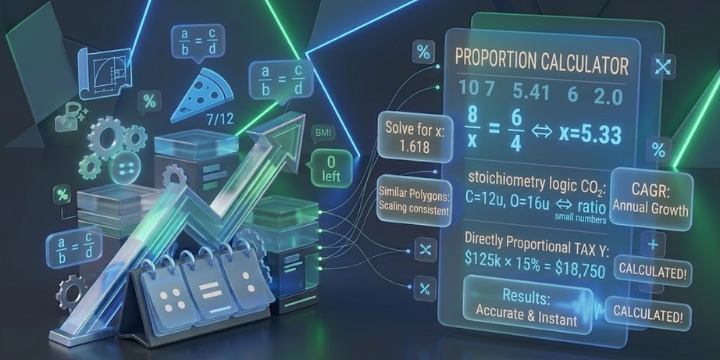
The proportion calculator is designed to compute identical proportions and find missing values across a wide range of problems. It represents the equality of two ratios and applies cross multiplication to reach the solution efficiently. Both methods are grounded in the proportion definition — the idea that two ratios, when set equal, describe a consistent mathematical relationship. The tool also draws on the constant of proportionality to handle cases where parameters are either directly proportional or inversely proportional to one another. After reading through the examples and method breakdowns on this page, you will be able to tell which approach fits your problem best.
What makes this calculator particularly useful is how well it handles real-life proportion examples — from the law of multiple proportions in chemistry to the proportional tax definition familiar to any taxpayer or finance professional. Basically, if a problem involves two quantities scaling together or against each other, this tool can help you work through it. For related tools, the Fraction Calculator, Percentage Calculator, Average Calculator, Speed Distance Time Calculator all live within the same Math Calculator Category and pair naturally with proportion-based problem solving.
What Is a Proportion? – Proportion Definition
The Core Idea Behind Proportions
A proportion is a statement that two two ratios are equal — a foundational concept that shows up across math, science, and daily life. The symbol of proportion is ‘::’ and ‘=’, and understanding what these symbols represent is the first step toward solving proportions with confidence. At its core, a proportion definition describes a relationship between two quantities, showing what portion of one part sits within the whole. The result can take several forms: a fraction, a value with a colon, a decimal, or a percent. Your preference for percent-based display is completely valid — and if that’s your go-to format, the Percentage Calculator is worth a visit too, especially when working with 100 as the denominator.
Two Variables and How They Relate
When two variables are involved, a proportion tells you how they move relative to each other. If one variable is equal to the product of the other variable and a fixed constant, those variables are directly proportional. If the product of the two variables is a constant — meaning x·y is a constant — they are inversely proportional. Just as a fraction made up of two parts has a numerator and denominator, a proportion follows the same structure: the upper number of proportion acts as the numerator, and the bottom part of proportion serves as the denominator. The constant of proportionality ties it all together, and this holds true whether you’re scaling up or simplifying down.
A Practical Example to Illustrate
To illustrate this, suppose you have a birthday cake cut into 12 slices and your cheeky uncle has already eaten 5 slices, leaving slices remaining at 12−5=7. The proportion of slices left relative to the entire cake is proportion 7/12. If you wish to rewrite that using a colon, it becomes 7:12 — though note that the proportion calculator will not represent the latter form directly. You could also scale up this to a larger, equivalent proportion with a different denominator, which is exactly what the next section on solve proportions walks through. This process is straightforward once you understand how one variable equal to product relationships work — and this enables you to calculate things like the percent of cake eaten by your uncle with just a few steps. For further reading, the percentage calculator handles these percent-based display conversions seamlessly, while tools in the Math Calculator Category cover the broader quantities and scaling involved. The choice of method — fraction, decimal, or percent — depends on display needs, but the underlying math holds true across all of them.
What Is the Proportion Formula?
The proportion formula is stated as a:b :: c:d, where the double colon acts as the proportion symbol representing equality between two ratios. In fraction form, this same relationship is written as ab=cd — and because the equivalence works both ways, ba=dc holds true as well, making it a biconditional expression denoted by ⇔. The four proportional terms a, b, c, and d are connected through this mathematical formula using colon notation and ratio notation, where the numerator and denominator of each fraction form must maintain a consistent proportional relationship. Applying cross-multiplication to this equation — multiplying across the variables diagonally — is the most reliable way to verify or solve for any unknown within the two ratios.
a:b :: c:d ⇔ ab=cd | ba=dc
Steps to Solve Proportions
To solve proportions, the goal is straightforward: set two proportions with ratios equivalent to each other, identify the missing part, and assign an unknown variable — whether x, y, or z — to represent it. From there, the process moves through a clean sequence of operations involving cross multiplication, multiplying, dividing, and working with the coefficient to simplify down to a clean answer. Every step revolves around maintaining balance across the equal sign, keeping numerator and denominator relationships intact throughout your calculations.
- Set two fractions across an equal sign and place variable of your choice in the missing position
- Apply cross multiplication on both sides, pairing the numerator of one fraction with the denominator on the other side and vice versa, separating variables from any constant with an equal sign
- Simplify the variable side by multiplying or dividing by the coefficient depending on the situation, isolating whatever term is attached to variable
Alternatively, if the long process of manual calculations isn’t what you’re after, the proportion calculator handles it instantly — delivering answers in seconds alongside detailed steps so you can verify answers at every stage without the back-and-forth.
How to Solve Proportions?
There are two main ways to solve proportions — cross multiplication and the proportion formula — and knowing both gives you the flexibility to handle everything from straightforward ratios to more complex problems involving larger numbers and decimals. In either approach, the objective is the same: find the missing part by assigning an unknown variable (x, y, or z) and working through the solution systematically. The proportion calculator is always available to check answers and confirm your manual working.
- Cross Multiplication — construct proportion, apply cross multiplication across both sides, matching numerator against denominator, then simplify the variable by working with the coefficient and separating variables from any constant using the equal sign
- Proportion Formula — use a:b :: c:d, where ab=cd and ba=dc hold as a biconditional relationship expressed by symbol ⇔, producing equivalent fractions that let you solve for x directly
Using Cross Multiplication
Taking the example 8:?::6:4 With the unknown variable standing in for the missing value, you first construct the proportion as 8x=64. Applying cross multiplication on both sides gives 6x=32, and after multiplying and dividing through the coefficient on the variable side, you arrive at x=326, then x=163, and finally x=5.33. Throughout this process, keeping numerator and denominator correctly positioned across the equal sign is what makes the simplified step clean and reliable.
Using Proportion Formula
Using the same problem through the proportion formula — a:b :: c:d, ab=cd, ba=dc — you set up 8x=64, which reduces to x=81.5 and confirms x=5.33. This method works especially well when solving proportions manually for problems involving equivalent fractions, larger numbers, or decimals, since the structured format of the formula keeps every numerator and denominator relationship visible and easy to track as you solve for x.
Proportion Examples
To see how this plays out practically, consider scaling up the ratio 7/12 to a larger equivalent ratio with a denominator 96. Setting up two equivalent proportions as x/96 and applying cross multiplication gives 12x=672, solving to x=56. The steps follow the same sequence every time:
- Set up both fractions with the missing part assigned to a variable of your choice
- Place an equal sign between the ratio and proportion — they describe the same things
- Isolate variable using cross multiplication, swapping denominator and numerator vice versa
- Solve for variable
- Run the result through the proportion calculator to check answer and confirm solving proportions was done correctly
For a real-world spin, if the ratio of pizzas to burgers at a party is 3/5 and there are 15 burgers, setting up 5x=3×15 gives x=45/5, meaning x=9 — so there are 9 pizzas alongside the 15 burgers. The same logic applies when you need to adjust ingredients in a recipe for a larger number of guests — much like how a pancake recipe calculator scales quantities proportionally. Use the proportion solver whenever you need to solve fractions quickly from given values, particularly when the numbers get unwieldy and manually working to isolate variables vice versa takes longer than it should.
Constant of Proportionality – Values Being Directly and Inversely Proportional
The constant of proportionality — sometimes called the coefficient of proportionality — is the fixed value that links the ratios or products of two quantities in a consistent equation. Whether you’re working with directly proportional or inversely proportional variables, this value is what holds the formula together. Expressed as either c=yx or c=x×y depending on the type of relationship, it might sound like a theoretical concept at first, but its real-life applications are everywhere. Mathematically speaking, these constants quietly govern some of the most familiar relationships we encounter — most people just don’t recognize them by name.
Directly Proportional Variables
In a directly proportional relationship, the constant of proportionality is expressed as c=yx, meaning the ratio between two variables stays fixed as both values shift together. The most intuitive example is the relationship between speed, velocity, distance, and time — captured in the familiar formula v=st. This ratio of distance and time is a textbook case of a constant relationship: when you change one variable, the other adjusts to match. With time gradually increasing, the distance covered will rise proportionally, and when you need a shorter distance, the time value must decrease to maintain a constant ratio. You can use this to calculate distance over 1 minute, 1 hour, or 1 day with equal reliability. Other strong examples of directly proportional variables are concentration and density, where the relationship between mass and volume follows the same proportion definition — a directly proportional pairing governed by a stable constant of proportionality.
Inversely Proportional Variables
With inversely proportional variables, the constant of proportionality takes the form c=x×y — meaning the products of the two variables remain fixed rather than their ratio. The formula s=v×t illustrates this well in a traveling context: when distance constant stays the same, any change in velocity forces a corresponding change in time, and vice versa. An increase in velocity leads directly to a reduction in travel time — something anyone who’s driven at higher speed to reach a destination in a shorter period has experienced firsthand.
Flip it around and the same logic holds: if you want to prolong travel time — to admire the countryside or simply save on gas — a velocity decrease is what makes that possible, with the constant ratio preserved throughout. These real-life proportion examples show just how naturally inversely proportional relationships appear once you know what to look for. The ability to maintain and preserve balance between shifting variables is exactly what makes the constant of proportionality so useful when you need to solve proportions involving travel time, increase, reduction, or any other paired quantities that move in opposite directions.
The Golden Ratio
The golden ratio is a special ratio found throughout nature and construction, achieved when two quantities share the same proportion as the sum of those quantities to the larger quantity. This relationship occurs wherever balance and beauty intersect — from architecture to organic shapes — and yields a fixed value 1.618, an approximate value since the result is a non-terminating decimal. The formula a+b/a=a/b defines it precisely, where a and b represent the two quantities, a+b forms the total, and the brace notation in a visual representation often splits this into two sections — a blue rectangle for a and a pink rectangle for b.
It may seem complicated at first, but things get clearer once you see it applied: a golden rectangle with width w=a and length l=a+b is special because the ratio a+b/a always resolves to that same value 1.618. The golden ratio also sits at the limit of the consecutive Fibonacci numbers — each new Fibonacci numbers ratio nudging closer to this value without ever landing on it exactly. The golden ratio calculator can compute this instantly, while the golden rectangle calculator handles compute length and width for any rectangle you want to test.
In geometry, the proportion calculator becomes particularly handy when working with similar polygons. By definition, two polygons are similar when their sides in proportion — meaning corresponding sides and angles scale consistently from one shape to the other. The most common application of this is with triangles, where the law of sines is based on the fact that a proportional relationship between sides and angles governs the entire triangle. This proportional relationship holds across l and w measurements alike, making the tool equally useful whether you’re analyzing a rectangle, comparing similar polygons, or verifying angle-side consistency across any triangle in a broader geometry problem.
Law of Multiple Proportions – Proportional Relationships in Chemistry
The ability to solve proportions becomes genuinely handy when dealing with chemical reactions, and nowhere is this more formalized than in the law of multiple proportions — one of the fundamental rules of stoichiometry discovered by British chemist John Dalton. Dalton’s statement established the methodology of calculating amounts of reactants and products in a reaction: when two elements form more than one compound, the ratios of masses of the second element combining with a fixed mass of the first element will always be small whole numbers.
Scientifically speaking, if you divide the masses of atoms of different elements forming a single particle — take CO₂ (carbon dioxide) as a straightforward case — you consistently land on a constant ratio made up of small numbers specific to that particle. For more complex yield problems, the theoretical yield calculator pairs well with this kind of proportional thinking across chemical reactions.
To make this concrete, consider sulfuric acid (H₂SO₄) and how its specific ratio is worked out step by step:
- Count numbers of atoms of particular elements in sulfuric acid: 2 atoms hydrogen, 1 atom sulfur, 4 atoms oxygen
- Calculate total mass of each element using the atomic mass unit (u): a single hydrogen atom weighs 1 u, one atom oxygen weighs 16 u, and one atom sulfur weighs 32 u
-
- Joint mass hydrogen atoms: 2×1 u=2 u
- Total mass oxygen in the sulfuric acid particle: 4×16 u=64 u
- One atom sulfur — weight of sulfur equals 32 u
- Divide all numbers against each other, keeping everything as whole numbers with no fractions: H/O/S=2/64/32=1/32/16
- The result is a clean ratio of small numbers for the particle of sulfuric acid
This means that for every 1 g of hydrogen H, you need 16 g of sulfur S and 32 g of oxygen O to ensure all atoms participate fully in the reaction with no leftovers. Using the proportions calculator, you can verify that 352 grams of sulfur reacts fully with the corresponding grams of hydrogen and grams of oxygen — try it yourself. Beyond H₂SO₄, proportional relationships in chemistry extend further: molarity describes the relationship between moles of a solute (a dissolved substance) and the volume of solution, while ABV (alcohol by volume) tracks the volume of alcohol relative to the total volume of drink — a ratio that amateur chemists and home brewers work with regularly. The same proportional logic runs through all of it, with stoichiometry simply being the most rigorous framework for applying it.
Directly Proportional Tax Definition
Our beloved proportions show up in finances just as reliably as they do in science, and proportional taxation is one of the clearest real-world examples. A proportional tax works on a simple principle: the tax rate is fixed, meaning everyone undergoing proportional taxation pays the same percentage of their income regardless of how much they earn. To illustrate with an example, a proportional tax rate of 15% applied to person X with an income of 15,000$ produces a straightforward calculation: 15,000×15%=$2,250 owed by the end of tax year. The similar formula applies to person Y who earns 125,000$ — the fixed rate requires the same approach, giving 125,000×15%=$18,750. Although the amount of tax paid by person Y is greater in absolute terms, both are paying the same part of their income as whole — 15/100, or 15%.
- Proportional tax rate 15%, person X, income 15,000$, tax 2,250$
- Person Y, income 125,000$, tax 18,750$, same percentage, 15%
- Progressive tax, income under 100,000$, pay 20%, income over 100,000$, tax rate 25%
- Law of multiple proportions: 352 grams sulfur reacts fully with 22 grams hydrogen and 704 grams oxygen to produce sulfuric acid
The contrast worth understanding is the difference between proportional tax and the progressive tax — probably the most popular type of tax in use globally. While both taxes require you to pay a certain percent of your income, the progressive tax introduces percentage changes tied to increase of income, applying specific tax rates across defined ranges of income value. For instance, people earning under 100,000$ might pay 20% earnings, while those above that threshold face a tax rate of 25%.
The key difference is that a proportional tax keeps the rate flat for everyone, making it straightforward to calculate at any income level — no bracket thresholds, no shifting rates, just one fixed percentage applied consistently across all finances. As a final note, the answer to the earlier question from the chemistry section: by the law of multiple proportions, 352 grams sulfur will react fully with 22 grams hydrogen and 704 grams oxygen to form sulfuric acid.
FAQ’s
What Is a Proportion?
A proportion is a relation or equation that compares two different ratios and confirms whether they are equal to one another. To put it plainly with an example: if a total class size is 100 students made up of 20 boys and 80 girls, then the proportion of boys is 20/100 — which is 20% — while the proportion of girls works out to 80/100, or 80%. This kind of comparison is what proportions are built for: taking fractions, numbers, or quantities and expressing how their ratios equal each other in a clear, structured way.
Is Proportion a Type of Ratio?
Yes — proportion is a type of ratio, and both are used with the shared intent of comparison. The distinction is subtle but important: a ratio is the comparison of two numbers or quantities directly, while a proportion extends that into a comparison of two ratios, confirming that two separate fractions of numbers or quantities hold the same comparison of fractions relationship. In short, every proportion involves ratio thinking, but not every ratio constitutes a proportion.
What Are the Types of Proportion?
There are three types of proportions — direct proportion, inverse proportion, and continuous proportion — each describing a different way that two ratios can relate through their values, numerator, and denominator.
- Direct proportion: when the values on one side ratio increase, the other increases as well, and the same holds vice versa — both sides of the two ratios move in the same direction together
- Inverse proportion: a comparison two ratios where the denominator decreases as the numerator increases — and vice versa — so as one doubles, the other halves, making it a classic example of opposing movement
- Continuous proportion: a comparison of ratios where the consequent and antecedent of the two ratios are not same, requiring you to multiply a term until the ratios are converted into a continued proportion