Understanding Significant Figures
Significant figures, often shortened to sig figs, are the meaningful digits in any measured or calculated number — and understanding them is fundamental to working with precision in mathematics and science. In practice, leading zeroes and trailing zeroes can often be removed without affecting accuracy, since 004 means exactly the same as 4. What matters is your ability to identify which digits carry real value, so you can retain the accuracy of any measurement. When you round a number up or down, one or more of the significant figures are altered, which is why knowing the common rules of significant figure operations is essential before removing digits from any value. Whether you’re working with whole numbers, real numbers, or expressions in scientific notation and e notation — such as 3500, 35.0056, 3.5 x 10^3, or 3.5e3 — the same core principles apply. This topic sits within a broader mathematical framework that also connects to tools like the Scientific Notation Calculator, Statistics Calculator, Exponent Calculator, Average Calculator, and the wider Math Category of computational resources.
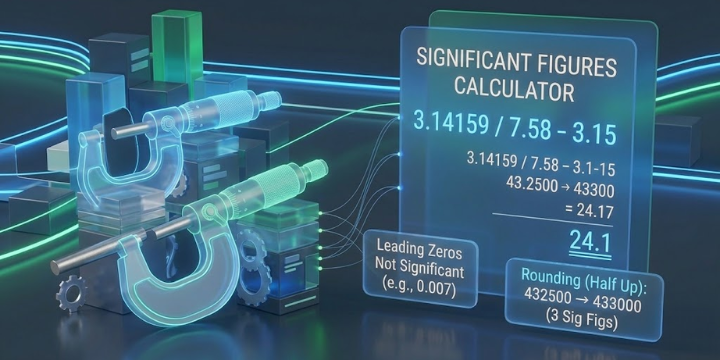
Significant Figures Calculator: Perform Operations & Count Sig Figs with Precision
A reliable significant figures calculator does far more than simply counter digits — it helps you perform arithmetical operations that include addition, subtraction, multiplication, and division, delivering results that are rounded to the correct number of sig figs automatically. You can also use this tool as a dedicated sig fig counter: just enter the number, and it will display the total count of significant figures in it while it will highlight the least significant digit for clear visual reference. For those who prefer watching over reading, a short video — crafted to teach everything you need in just 90 seconds — makes learning even more accessible. To use it effectively, simply enter a value of any quantity you provide — from whole numbers to real numbers or values in scientific notation — and review the results instantly. Understanding how to learn, apply, and review significant figure operations through such an interactive sig fig counter builds both speed and confidence in numerical work.
How to Use the Significant Figures Calculator Effectively
Using this significant figures calculator is straightforward — let us guide you toward its best use across a range of numerical tasks. To get started, simply enter a number — whether it’s a whole number, a real number, or a value expressed in scientific notation — and the calculator will instantly summarize the results, including the decimal notation and the total count of significant figures present. For arithmetical operations, you can input a full expression such as 3.14 / 7.58 – 3.15, and the sig fig calculator will not only process the calculation but also provide a detailed step-by-step solution, making it especially valuable for learners and professionals alike. The tool will also underline the least significant digit within your result for immediate visual clarity. When a specific precision is desired, simply use the “Round to sig fig” option by selecting the number of figures you need — for instance, when working with 24.0725, the calculator identifies 6 significant figures with the least significant digit being 5, and displays it in both scientific notation as 2.40725 × 10^1 and E-notation as 2.40725e+1; if you then input 3 into the round to sig fig field, the decimal notation 24.1 appears instantly in the results section. To use this same tool as a dedicated sig fig counter, just enter the number and retrieve your count without any extra steps — the rounding method applied throughout is half up, ensuring consistent and reliable round off behavior across every arithmetical operation you perform.
What Are Significant Figures? Definition, Precision & Measurement Explained
In any scientific or mathematical context, significant figures are the digits within a measured value that genuinely reflect the precision of a measurement — and understanding them is essential before using any rounding calculator or computational section of a precision-based count tool. Every measurement carries some degree of uncertainty, largely because of the limitations of the measuring tool being used; for instance, a standard ruler can only resolve values to the nearest millimeter, meaning it can capture the length of a rod as 12.5 cm but cannot extend to a higher precision value like 12.51 cm — making this specific example one with exactly three significant figures. In practical terms, if that same rod appears to fall somewhere between 12.5 cm and 12.6 cm, you must estimate the result, and whatever last digit you record becomes the first uncertain digit, also called the least significant digit. To avoid carrying repeating figures that aren’t meaningful, numbers are often rounded — but one must be careful not to lose precision during rounding, as the entire goal is to simplify without sacrificing accuracy. Working in centimeter or millimeter scale, even a 1/10th shift in value can change the outcome of a calculation, which is why these problems demand both attention and the right tools — and that’s precisely where a dedicated rounding calculator proves its value for anyone looking to measure and count significant figures with confidence.
What Are the Significant Figures Rules? A Complete Guide to Counting Sig Figs
Before you can confidently determine which digits in any number are truly meaningful, you need to understand the core significant figures rules that govern how significant and non-significant values are identified. The first thing to recognize is that a zero placed to the left of a decimal value that is less than 1 is never significant — it exists purely as a placeholder. Similarly, leading zeros are never significant, while zeros between non-zero digits are always significant, and so are all non-zero digits themselves. Trailing zeros acting as placeholders are generally non-significant, but when a number contains a decimal point, those same trailing zeros become always significant — a distinction that directly affects the value and accuracy of your result. To help remember these common rules, think of them as a structured framework: non-zero numbers always count, zeros only count under specific conditions, and leading zeros never count — making it much easier to count sig figs accurately across any context.
When a number holds more digits than the desired number of significant figures, it must be rounded using a consistent method — typically half up, also known as regular rounding. For example, 432500 becomes 433000 when expressed to 3 significant digits, but those end of numbers zeros cannot simply be removed, as doing so would distort the value entirely — unless the number is converted into scientific notation. In rounding significant figures, when an integer has more digits than those that are significant, the last significant digit is marked with an overline to clearly signal that it is the last significant digit in that expression. Understanding these significant figures rules and applying rounding of significant figures correctly is what separates a precise calculation from a misleading one — and it’s the foundation upon which every reliable significant digit and significant figures tool is built.
More Examples of the Sig Fig Calculator Usage Across Different Number Types
The significant figures calculator operates in two modes — it either performs arithmetic operations on multiple numbers (such as 4.18 / 2.33) or simply rounds any number to your desired number of sig figs. To calculate sig figs by hand or through the significant figures counter, it helps to consider a few practical cases. Take the decimal 0.004562 as an example: the trailing zeros act as placeholders and do not count, so when we round 4562 to 2 digits, the result becomes 0.0046, giving us exactly 2 significant figures. For a non-decimal number like 3453528, rounding to 4 significant figures means reducing the entire value to the nearest thousand, which yields 3454000. These rules remain consistent whether you’re working with small number values or large integers, and the rounding logic the tool applies follows the same convention across all arithmetic inputs.
When a number is expressed in scientific notation, the same rules apply — and the sig fig calculator makes this seamless by accepting E notation as input, which replaces the standard × 10 format with either a lowercase or uppercase letter e. For instance, 5.033 x 10²³ is equivalent to 5.033E23 or 5.033e23, while the small number 6.674 x 10⁻¹¹ is entered as 6.674E-11 or 6.674e-11 — a convention also used in the scientific notation calculator. For estimation tasks, the number of significant digits should not exceed the log base 10 of the sample size, rounded to the nearest integer; with a sample size of 150, the log of 150 is approximately 2.18, so 2 significant figures is the appropriate count. Whether you’re working with arithmetic operations across multiple numbers or applying estimation logic to statistical data, the sig fig calculator performs with precision across all entire value ranges and cases.
Significant Figures in Mathematical Operations: Rules, Examples & Precision Guide
When you obtain a calculated result by performing arithmetic operations or broader mathematical operations on two or more variables, any uncertainty in the original measurement will directly affect the results — making it essential to apply significant digit rules at every stage. Consider an object whose mass is 5.452 g (four significant figures) and whose volume is 1.67 cm³ (three significant figures); expressing its density as 3.26467065868 g/cm³ would be irrelevant and incorrect, since the least precisely measured variable — volume — limits the precise output to just three significant figures, giving the final result as 3.26 g/cm³. In general, the calculated result should always equal the number of sig figs found in the least precision input. For addition and subtraction, the rule governs decimal places: in the operation 128.1 + 1.72 + 0.457, the value 128.1 has the fewest decimal places — just one decimal place — so the final result 130.277 is correctly expressed as 130.3, with underlining used to mark the position of the last significant number as indicated by standard convention.
For multiplication and division, the rule shifts to controlling the count of significant figures rather than decimal places: in 4.321 × 3.14, the value 3.14 carries the fewest sig figs (three significant figures), so the intermediate result 13.56974 is rounded to the accurate final result of 13.6. In mixed calculations combining addition, subtraction, multiplication, and division — such as 12.13 + 1.72 × 3.14 — it is sufficient to track sig figs at each step: after multiplication, you get 5.848, and adding 12.13 gives 17.978, correctly rounded to 18.0 while applying significant digit rules only at the final result stage without rounding the intermediate result prematurely. Exact values such as conversion factors, pure numbers, and defined numbers are treated as having infinite significant figures and do not affect precision — for example, in a speed conversion from m/s to km/h, multiplying 15.23 by 3.6 yields 54.83, where significant figures are still determined by 15.23; entering 3.600 into the calculator preserves this logic. For anyone tackling complex mathematical problems involving more than one operation, understanding the distributive property alongside these rules provides a complete framework for working with variables, measurement, and uncertainty at every level.
How to Calculate Significant Figures: Rules, Examples & Common Principles Explained
To calculate significant figures accurately, you need to identify which digit in any given number is significant and which is not significant — and the significant figures rules make this clearly structured once you go into a bit more detail. The first rule is straightforward: any non-zero digit is always significant, without exception. A zero becomes significant when it appears between other digits or sitting between two non-zero digit values — for instance, 205 is not the same as 25, and 3.604 retains its zero as fully significant following the same line with rule (2) explained above. The role of the decimal point is equally critical: when considered alongside trailing zeroes, it determines whether those zeroes come after a meaningful value or simply serve as placeholders. A number like 90.7500 confirms precision to four decimal places — those trailing zeroes significant markers tell us the measurement is completely exact, ruling out the possibility that 90.75 was merely rounded down from something like 90.7511. Without the decimal point, the same trailing zeroes would be unnecessary and not significant.
Understanding when leading zeroes are not significant can be confusing at first glance, but the principle is consistent: 00200 means the same as 200, and 007 is simply 7 — the leading zeros add nothing precise to the value. Even when leading zeroes come after a decimal point, they remain not significant; 0.01kg of grapes and 1kg of grapes are clearly different, yet 0.01kg can equally be expressed as 10g — it is the 1 that carries the significant weight, not the leading zeros. However, if a zero is sitting between two significant digits, as in 2.303, it is fully significant and must be considered accordingly — this is the involved distinction the significant figures rules make completely clear. For trailing zeroes, the rule is equally decisive: they are trailing zeroes significant only when a decimal point is involved, and not significant when there is none — a detail that directly affects how precisely a number is expressed across two decimal places, four decimal places, or any other level of precision you’re working within.
How Many Significant Digits Are There? Examples, Count & Calculations Explained
Working through significant figure calculations with real examples is one of the most effective ways to build a solid count of how many significant figures or significant digits appear in any given number — and the patterns become intuitive quickly once you see them laid out clearly. The simplest case: 7 contains just 1 significant figure, while 73 carries 2 significant figures (6 and 3 are the relevant non-zero digits in similar two-digit values). Moving to three-digit figures, 673 holds 3 significant figures, whereas 100 holds only 1 significant figure because its trailing zeros without a decimal point are not counted in the calculations. When decimals enter the picture, the rules shift: 673.52 extends to 5 significant figures across its 5 meaningful digits, and 0.0637 contains 3 significant figures since its leading zeros are excluded from the count while 6, 3, and 7 remain. For decimal places specifically, 30.00 holds 4 significant figures and 2 decimals — its trailing zeros are significant here because of the decimal point — while 0.0025 carries only 2 significant figures (2 and 5) despite having 4 decimals, as the leading zeros before them contribute nothing to the significant digits tally.
Sig Fig Calculator Operators, Functions & Symbols: Complete Guide
The sig fig calculator supports a full range of operators and functions designed to handle virtually any mathematical calculation you encounter — and knowing what’s available helps you get the most precise results every time. For standard arithmetic, the tool accepts addition (+), subtraction (-), division (/ or ÷), and multiplication (***** or ×), plus the exponent operator (^) for working with powers — covering the core operations where significant figures matter most. To manage order of operations clearly, grouping symbols such as parentheses (()) are fully supported, ensuring complex expressions are evaluated in the correct sequence. Beyond basic operators, the calculator also handles advanced mathematical functions including log and ln, which are essential in scientific and logarithmic calculation contexts. Alongside all of this, the tool provides a built-in counter — showing you the total number of significant figures for any expression entered — making it as much a dedicated significant figures auditing tool as it is a full-featured computational resource. The breadth of supported symbols and functions positions this sig fig calculator as a reliable solution across beginner to advanced scientific workflows.
FAQ’s:
These FAQs address the most commonly searched significant figures questions — each answer is grounded in the same rules covered throughout this page.
How Many Sig Figs in 100? Understanding Trailing Zeros Without a Decimal Point
One of the most commonly misunderstood cases when counting sig figs involves the number 100 — and the answer is simpler than it might first appear: 100 has only one significant figure, which is number 1. The reason comes down to a foundational rule governing trailing zeros: when there is no decimal point present in a number, those trailing zeros are not significant and do not count toward the total of significant figures. In 100, the two zeros that follow the 1 exist purely as placeholders to indicate magnitude — they carry no measurement precision on their own. The presence or absence of a decimal point is the single deciding factor here; without it, the trailing zeros in any number like 100 remain not significant, keeping the count of significant figures at just one. This principle is essential to grasp before using any significant figures tool, as it directly affects how results are interpreted and expressed across scientific, mathematical, and everyday measurement contexts.
How Many Sig Figs in 100.00? Why the Decimal Point Changes Everything
A question that naturally follows from understanding 100 is: how many sig figs does 100.00 have — and the answer reveals just how much a single decimal point can change things. Unlike 100, which holds only one significant figure, 100.00 contains five significant figures across all its digits, because the decimal point is present and that single detail transforms the entire interpretation. When a decimal point appears in a number, trailing zeros are no longer dismissed as placeholders — they actively count as significant figures, each one confirming a greater degree of measurement precision. In 100.00, every one of the five digits is significant, communicating that the number is known to an exactness of two decimal places rather than being a rough approximation. This contrast between 100 and 100.00 is one of the clearest illustrations of why the decimal point matters so deeply in sig figs — its presence alone determines whether trailing zeros count or not, making it an indispensable concept for anyone working with precise numerical data.
How Many Sig Figs in 0.01? Leading Zeros and Why They Don’t Count
Another frequently searched case in sig figs is 0.01 — and just like with 100, the answer comes down to one clear rule: 0.01 has only one significant figure, and that single significant digit is number 1. The two zeros that appear before the 1 are leading zeros, and leading zeros simply do not count as significant figures under any circumstances — they exist solely to position the number correctly on the decimal scale and carry no measurement precision of their own. This means that when you count the meaningful digits in 0.01, only the 1 qualifies, bringing the total of significant figures to exactly one. It is worth noting that this rule holds even though a decimal point is present in the number — unlike trailing zeros, where the decimal point determines significance, leading zeros are always excluded from the count regardless of where the decimal falls. For anyone using a significant figures tool or working through manual calculations, recognizing that leading zeros do not count is one of the most practical and consistently applicable rules across all sig figs assessments.
How Many Significant Figures in the Measurement of 0.00208 Gram? Leading Zeros vs. Sandwiched Zeros Explained
Building on the rules we’ve already established for leading zeros and trailing zeros, the measurement of 0.00208 grams presents a slightly more nuanced case — one that combines two distinct rules within a single number. The answer is that 0.00208 contains three significant figures: the digits 2, 0, and 8. The three leading zeros that appear before 2 do not count as sig figs — they are placeholders that position the number on the decimal scale but carry no measurement precision, following the same rule that makes leading zeros consistently not count across all significant figures assessments. However, the 0 sitting between 2 and 8 is a different case entirely — it is one of the classic zeroes sandwiched between non-zero figures, and zeroes sandwiched in this way always do count as significant figures, because removing them would fundamentally alter the number and distort the measurement. This is why the count of significant figures in 0.00208 reaches exactly three — the 2, the sandwiched 0, and the 8 — a result that reflects both the exclusion of leading zeros and the inclusion of zeroes sandwiched between non-zero figures, making this gram-based measurement a textbook example of how digits are evaluated in real scientific contexts.
How Many Significant Figures in the Measurement of 100.10 in? All Digits Explained
The measurement of 100.10 inches is a particularly rich example in sig figs because it brings together multiple rules in a single number — and the result is that all figures are significant: 100.10 holds exactly five significant figures across all its digits. To understand why, it helps to work through each digit systematically. The 1 at the start is a non-zero digit and always counts without question. The zeroes sandwiched between the leading 1 and the following 1 — the double zeros in the middle — always count as significant figures because they are zeroes sandwiched directly between non-zero figures, a rule that applies without exception. The second 1 is again a non-zero digit and fully significant. Finally, the trailing zeros after the decimal dot always count as significant because the decimal point is present in the number — which is the decisive factor that makes trailing zeros qualify as sig figs in any measurement. The presence of the decimal dot here is what elevates 100.10 from a potentially ambiguous number to one where all figures significant can be stated with complete confidence, making this inches-based measurement an ideal example for understanding how the count of significant figures is determined when multiple digit types appear together.
What Is 2648 to Two Significant Figures? Rounding Digits Step by Step
When asked to express 2648 to two significant figures, the process is straightforward once you understand how rounded values are determined by isolating only the most meaningful digits in a number. Starting from the left, the first two significant figures in 2648 are 2 and 6 — the remaining digits, 4 and 8, fall beyond the desired precision and must be replaced. Since we are rounding to two significant figures, we look at the third digit — 4 — to decide whether to round up or keep the second digit as is; since 4 is less than 5, the 6 stays unchanged, and the trailing digits become zeros to preserve the magnitude of the original number. The result is 2600 — a cleanly rounded number that retains the scale of 2648 while expressing it to exactly two significant figures. This example demonstrates one of the most practical applications of significant figures in everyday calculation: reducing a number to a specified level of precision without distorting its overall value, a skill that becomes effortless with consistent use of a reliable significant figures tool.